

Before Changing, Understand Legacy
Your System Beneath the System


Stop Celebrating New Systems
Start Explaining Your Legacy Ones.
Here’s a pattern worth challenging: we celebrate every new system—but rarely explain the ones still quietly running underneath.
In OD conversations, we love the new. New frameworks. New processes. New platforms. We present them with clarity and confidence. We walk people through how they work, why they matter, and what they will improve.
But almost never do we pause and ask:
What is the system we are standing on right now?
Because here’s the truth: in most organizations, the “old” system doesn’t disappear.
It becomes a legacy system—still running, still critical, but no longer fully understood.
Legacy Systems Don’t Go Away
They Stay—and Shape Everything.
A legacy system is not just an old system. It is a system that continues to operate long after its original context has changed.
It still processes decisions.
It still influences behavior.
It still carries risk.
And often, it does all of this quietly.
As highlighted in the video, legacy systems persist not because they are ideal, but because they are deeply embedded and hard to replace. They are connected to other processes, dependent on accumulated knowledge, and intertwined with how work actually gets done.
So while we talk about “introducing something new,” the organization is often still living inside the legacy system.
The Real Risk: Changing What We Don’t Understand
Here’s where it gets uncomfortable.
When we introduce new systems without understanding the legacy ones, we are not replacing—we are layering.
We build on top of:
· Workarounds we didn’t design
· Assumptions we didn’t question
· Practices we didn’t fully see
And over time, complexity increases—not because the new system is flawed, but because the old one was never fully surfaced.
This is how organizations end up with systems that look elegant on paper but feel heavy in practice.
Legacy: The Stories We Stopped Telling
Every legacy system has a story.
It was introduced for a reason. It solved a real problem. It worked—often very well—for a period of time.
Then things shifted.
People adapted. They adjusted the system to keep it useful. Some parts were reinforced; others were quietly ignored. Documentation fell behind reality. The people who deeply understood it moved on.
And eventually, the system became something else:
still active, but no longer clearly explainable.
That’s what makes it “legacy.” Not just age—but a loss of shared understanding.
Don’t Fix It. Surface It!
As OD practitioners, the instinct is often to fix, improve, or replace.
But with legacy systems, a more powerful move is to surface before you solve.
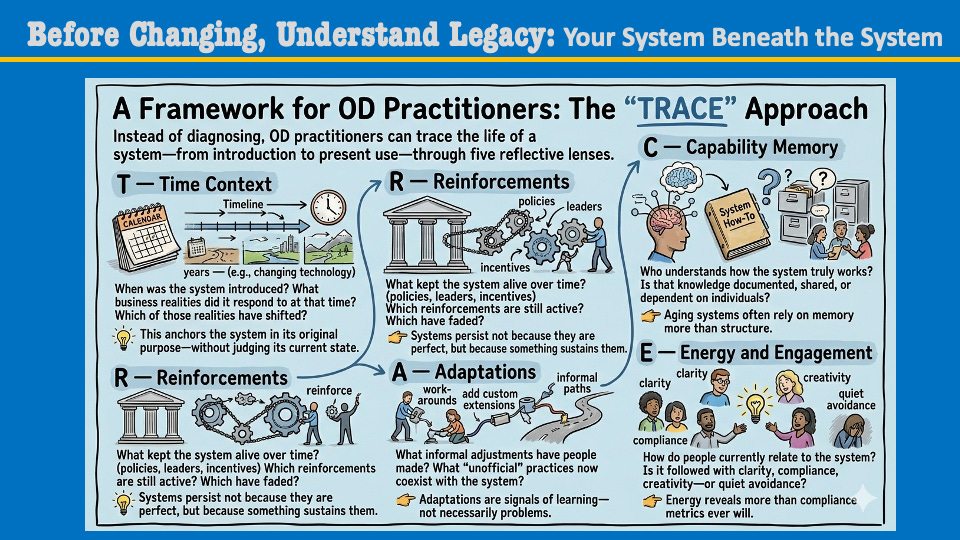
Go back and trace it.
What was happening when this system was first introduced? What made it necessary? What conditions allowed it to succeed?
Then follow its path forward. What kept it alive? What did people change along the way? Where did unofficial practices begin to carry more weight than formal design?
Who still understands how it really works?
And perhaps most revealing: how do people actually relate to it today—do they engage with it, work around it, or simply comply?
No diagnosis. No judgment. Just clarity.
When a System Becomes Legacy, Not Just Old
There’s a subtle but important shift when a system becomes a legacy system.
It is no longer just aging—it becomes foundational but fragile.
It continues to support the organization, but fewer people can fully explain it. It remains critical, but is harder to change. It is still relied upon, but increasingly surrounded by patches, exceptions, and dependencies.
This is why legacy systems are so hard to retire.
Not because they are valuable in their current form—but because too much depends on them in ways that are not fully visible.
Before You Change Anything…
Try this discipline.
Before presenting a new system, take a moment to describe the legacy system it will touch.
Not its flaws. Not its limitations.
Its life.
What did it enable when it was introduced?
How did people adapt it to make it work?
What does it still quietly support today?
If you cannot explain that clearly, then the new system is not starting from zero—it is starting from something you don’t yet understand.
And that is where most unintended consequences begin.
The Work We Often Skip
OD is not just about designing better systems.
It is about making the invisible visible.
Legacy systems are not obstacles to innovation. They are evidence of past innovation—still alive, still influencing, still shaping outcomes.
The real work is not to rush past them.
It is to understand them well enough that when you introduce something new, you are not unknowingly carrying forward the same patterns.
Because legacy systems don’t just sit in the background.
They are the ground you are building on.
NOTES:
ODPN Courses
Essentials of OD Course, by Ms Milalin Javellana and Ms Tita Puangco, April 22 to May 29 in-person, 8am to 5pm, in the Meralco Power Tech, Ortigas.
Ed Canela’s Courses
Everyday AI for Government Officers: The Fundamentals, May 21, 9:00 to 12:00 noon via Zoom. Register now or inquire from LYCA.
AI Course for Laguna Tours and Travels Network (LTTN) 28 April, 5 and 12 May, 2026; 3 Tuesdays (9:00 am to 5:00 pm), UP Institute for Small Scale Industries.
AI for Accounting BPOs May 26 via Zoom only special invites only.