
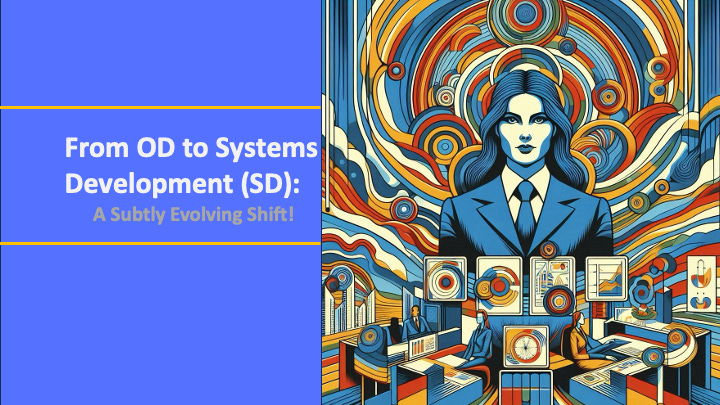
From OD to SD:
A Subtly Evolving Shift!

For decades, OD has been the trusted compass for leaders. It taught us how to nurture culture, empower people, and build adaptive organizations. Many of us cut our teeth on change-management workshops, team-building retreats, and leadership programs that focused on the “soft stuff” that really mattered.
But quietly—and perhaps without us noticing—another language has begun dominating boardrooms and business playbooks: systems development (SD).
Where OD says “invest in people,” SD says “build processes.”
Where OD celebrates culture, SD insists on checklists, workflows, and documentation.
Where OD uplifts heroes, SD designs systems that don’t rely on them.
This is not just a passing trend. It’s a profound shift in how organizations think about growth, resilience, and transformation.
Why the Shift?
Today’s organizations face relentless challenges: competition is global, disruptions are the norms and scale is demanded almost like, overnight. Leaders are realizing that culture alone cannot carry this weight.
Complexity is growing. One misaligned (and repeated, many times) workflow can cost millions.
Scalability is non-negotiable. You can’t grow on charisma—you grow on systems.
Continuity is survival. If operations depend on one or two “veteran heroes,” the business is fragile.
That’s why owners and executives are now obsessed with systematization—documenting processes, assigning ownership, creating SOPs, and integrating technology. The system, not the individual, becomes the hero.
Ironically, this move toward systemization isn’t about cold efficiency—it’s about liberation. Without clear systems, leaders become bottlenecks and staff drown in firefighting. With them, people are freed from chaos to do higher-value work.
So, is it now OD vs. SD?
So, where does this leave OD?
Does it fade into irrelevance, or does it evolve to embrace the language of systems?
The truth is: OD without SD collapses. SD without OD suffocates.
OD alone leads to passion without process—great energy, poor execution.
SD alone leads to precision without purpose—flawless workflows, disengaged people.
The sweet spot is the blend: culture supports systemization, and systems empower people. But here’s the catch—when complexity and scale are at stake, systems must lead.
Consider Digital Transformation
Consider how many digital transformations fail. The story is painfully familiar:
Leaders announce transformation as a “people project.”
Employees attend townhalls and workshops on culture change.
New tools are rolled out—without mapped workflows, SOPs, or ownership.
What happens?
Workflows stay undefined.
Data lives in silos.
Accountability blurs.
Tools get abandoned.
Good intentions, poor execution!
Now flip the script with a systems-first approach:
Processes are mapped before tools are installed.
SOPs provide step-by-step consistency.
Data is integrated across functions.
Clear owners are accountable for every process.
Suddenly, digital transformation sticks—because the system holds it together.
The Grandma’s Sauce
Looks like: relying on OD alone will doom complex changes. The winning formula is simple:
OD (People) + SD (Systems) = Sustainable Transformation
Use OD to engage, build trust, and clarify the “why.”
Use SD to ensure clarity, repeatability, and accountability.
The balance shifts depending on the challenge:
Scaling? → Lean on SD.
Culture shock? → Lean on OD.
Digital transformation? → Lead with SD, supported by OD.
Don’t Get Left Behind!
As OD practitioners, we need to recraft and retool. We can’t just be facilitators of dialogue and culture anymore. We must also become the architects of systems—or at least allies of those who are.
That means:
Learning the basics of systems mapping.
Partnering with IT and process engineers.
Embedding SOPs, workflows, and accountability structures into our change programs.
The world doesn’t need to be OD versus SD. It needs OD that understands SD.
So…
Organizations cannot become living systems if today’s leaders do not take that literally. They should aim for organizations with functioning organs, clear blood flows, and reliable rhythms.
The question is not whether this shift is happening—it is! The real question is: Will OD remain relevant by embracing systems, or will it be remembered as a relic of the pre-digital age?
The Choice is in our Hands
A short video on strengthening the systems in your organization. What systems are, what makes organizations with weak systems unsustainable, and where to get help to support your teams to build strong systems using Internal control tools!