
Human-Centered Work in a High-Tech World:
Why HR and OD Will Not Be Replaced by AI

So privileged to host the article of Abegail Tongco, PhD OD/ Abi is an OD consultant, mentor, coach, and facilitator. With nearly two decades of training and consulting experience, she has helped organizations strengthen their culture, leadership, and talent strategy through evidence-based consulting and coaching.
Artificial Intelligence has never been more fascinating. With each passing month, we see new tools, breakthroughs, and applications promising to transform how we work. Canva, for instance, has launched enhanced functionalities in its Visual Suite, practically automating the most tedious tasks in video editing. Canva Website now creates interactive forms that instantly convert responses into organized data sheets. In fact, Canva Design Model is now integrated directly with ChatGPT, thus, putting AI exactly where many of us do our everyday creative work.
Against this backdrop of rapid advancement, a recent article from ETHRWorld explored why certain professions including legal and healthcare are more “AI-proof” than others. The insights make one thing clear: as powerful as AI becomes, some work remains inherently and profoundly human. Working in Organization Development with various clients in different industries, I see the same pattern emerging. Generative AI has made it remarkably easy to articulate thoughts, craft messages, and organize information—tasks that once took hours now take minutes. Whether it’s a well-structured scope of work, a compelling social media caption, a synthesized set of workshop outputs, or a structured course outline, AI can support the process but still cannot replace the human behind it.
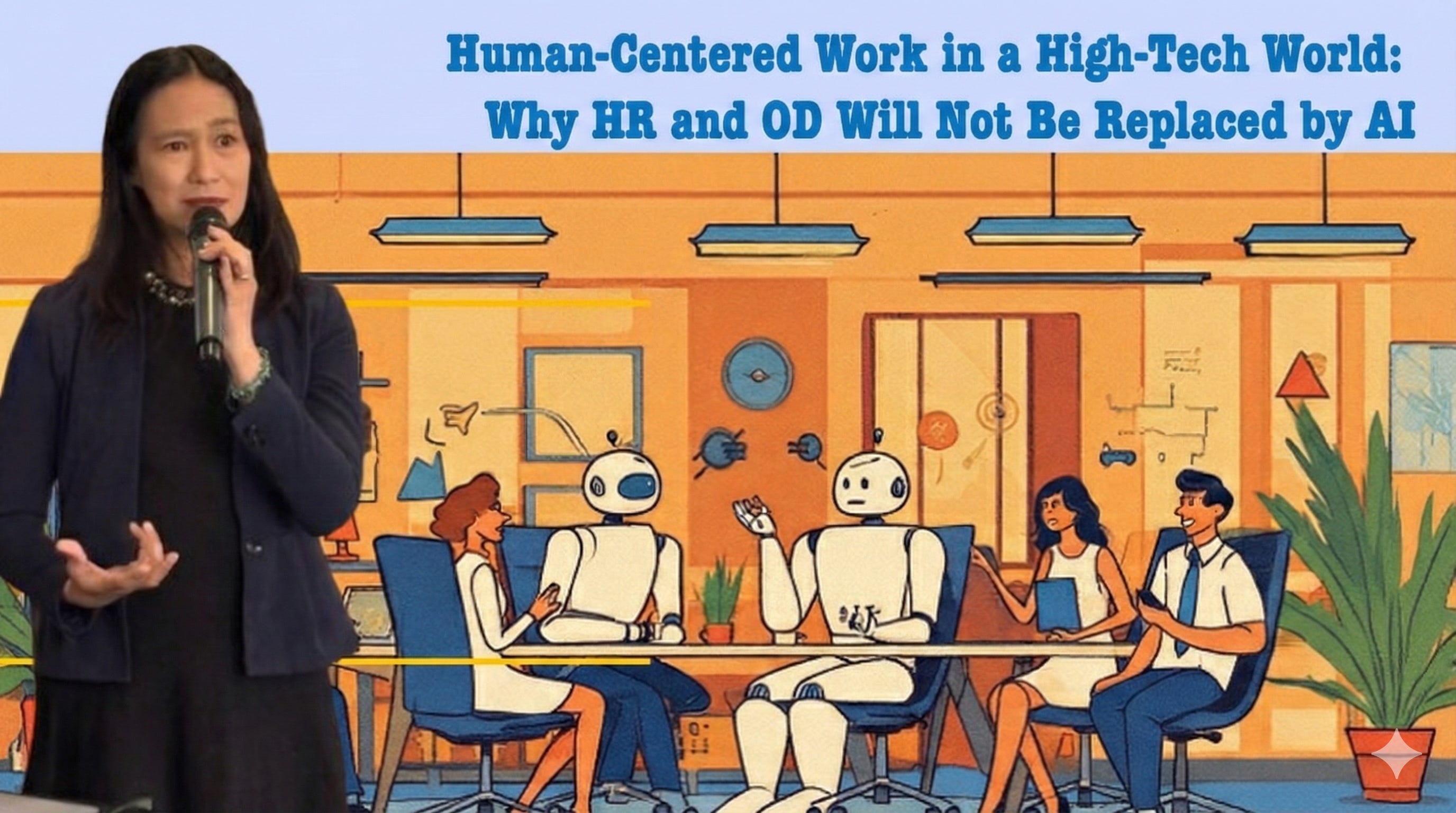
After all, a hammer cannot build furniture without a carpenter. An oven cannot create a cake without a baker. And AI, no matter how advanced, cannot cultivate culture, navigate team dynamics and corporate politics, rally people to support a strategy, influence people to follow a set of standards and protocols, or design systems that inspire people to perform at their best. Those functions require human wisdom, emotional intelligence, and actual learning experiences.
This is ultimately why OD roles are far from being replaced. If anything, AI elevates the importance of our work.
The Rise of AI—and the Rise of Human Ingenuity
AI excels at eliminating routine tasks. It simplifies documentation. It speeds up content creation. It automates repetitive workflows. These are gifts that free us to focus on meaningful, high-impact work.
But this also means that the tasks left for humans are becoming increasingly complex—requiring creativity, judgment, ethical discernment, and emotional intelligence. When I watch my children study, I sometimes wonder why their teachers still require them to memorize capital cities, historical dates, or the names of classical authors. These were things I memorized as a child but never truly used in real life. And in a world where information is instantly accessible, none of the jobs 20 or 30 years from now will require memorization.
What will matter are the distinctly human capabilities:
the ability to think critically
to connect ideas
to collaborate across differences
to empathize
to reason ethically
to influence, engage, and inspire
These are the skills that AI cannot replicate—and the very skills HR and OD exist to strengthen.
The OD Imperative in the Age of AI
If routine tasks disappear, organizations will rely heavily on capabilities rooted in human strengths. It becomes our noble obligation to prepare today’s workforce and the generations after them for this complexity.
To do this, OD must lead in several critical areas:
1. Building AI-Proof Organizational Capabilities
Organizations can no longer focus solely on technical skills, which evolve too quickly. Instead, OD must cultivate future-ready capabilities such as:
systems thinking
creative problem solving
collaboration and communication
emotional and social intelligence
ethical decision making
These ensure individuals remain relevant not only in their next role, but well into the next era of work.
2. Fostering Cultures of Continuous Learning and Experimentation
Innovation thrives in cultures that welcome curiosity and embrace learning. OD must help organizations move away from fear-based cultures where mistakes are punished. In an AI-enabled world, experimentation must be encouraged, agility celebrated, and iteration normalized. Innovation becomes impossible when perfection is demanded on the very first try.
3. Equipping Leaders to Facilitate Learning
Leaders today must evolve into coaches, not just teachers. Their role is to cultivate their teams’ ability to learn independently through guiding reflection, asking the right questions, and creating opportunities for hands-on practice.
A supervisor or manager who cannot facilitate learning will limit the organization’s ability to adapt and thrive.
4. Designing Competency-Based, Skills-First Learning Programs
Traditional training programs which are content-centered are no longer enough. OD must architect agile, skills-first courses grounded in competency frameworks that align with organizational strategy, ensuring consistent capability building across levels.
5. Simplifying Systems That Constrain Creativity
Overly rigid processes suffocate innovation. OD must advocate for systems that guide performance without restricting creativity. Organizational structures and systems should provide clarity yet remain flexible enough to support experimentation and adaptation.
A Call to Action: Designing Human-Centered Jobs in a High-Tech World
As we embrace AI, the goal of Organization Development is to both leverage on technology and to humanize its integration. OD have a unique responsibility to ensure that organizations remain anchored on values, relationships, and meaning even as they adopt high-tech tools. Design human-centered workplaces, jobs, systems, and cultures in an increasingly AI-enabled world.
Because while AI will reshape how we work, the essence of any organization such as mission, vision, values, service, purpose, and connection remains ours to shape.
In the end, the future of HR and OD does not diminish because of AI.
It becomes more vital, more strategic, and more deeply human.
Stanford Professors discuss Human Centred AI
NOTES
Forthcoming Ed Canela’s AI Seminar Series
1. “AI and the Future of Intelligence,” for the TID 22 Group,, December 28, 2025 via Zoom. By special invite ONLY
2. Save the date and join our 2026 AI courses: (a) Hiring and Nurturing AI Talents in 2026 (January 27, Tue), (b) Advanced AI for Trainers and Facilitators (Feb 17) and (c) Advanced AI for Senior Government Executives (Mar 21) via Foldeography Academy. Pre-register here and we will send you the brochure.
Thanks for reading OD Play Notes! Subscribe for free to receive new posts and support my work.
Thanks for reading OD Play Notes! Subscribe for free to receive new posts and support my work. Attention Gmail Users: To keep receiving OD Play Notesseamlessly, please move our emails into your Primary tab: On desktop: Drag this email into the Primary tab at the top of your inbox. On mobile: Tap the three dots (upper right), select Move, then choose Primary. This ensures our updates on OD practices and trends don’t get lost among promotions.